
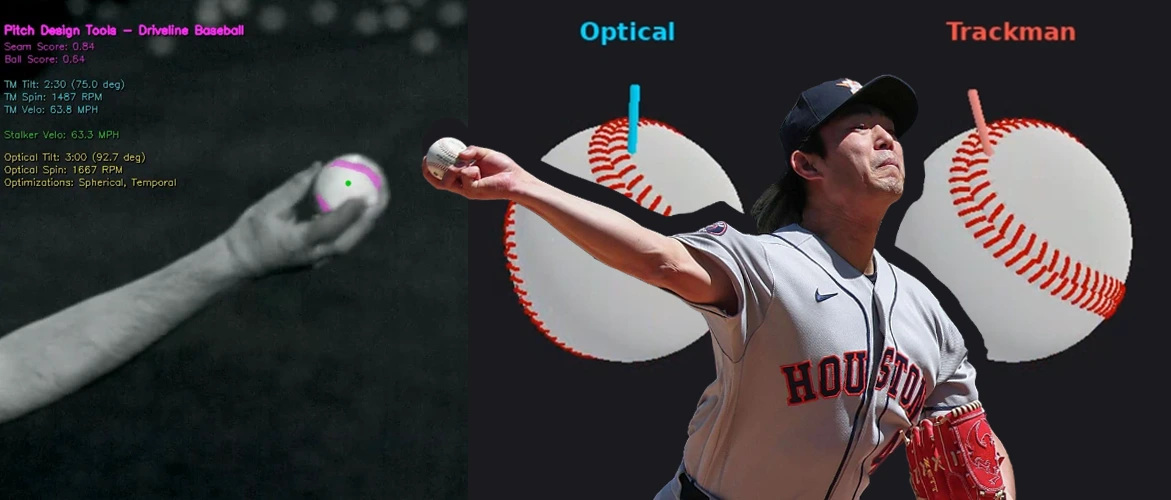
“Je pense que l’utilisation la plus applicable du CV à l’heure actuelle est… d’obtenir des mesures que je ne peux pas obtenir avec Hawk-Eye”, a déclaré Lambert. “I’m sure you can imagine if my high school brother is throwing a bullpen in Cincinnati and he just doesn’t have a Trackman, if we can get some footage, get some estimates of what’s going on, we can fine tune that process from there.”
Boddy et al at Driveline have done tons of labeling, heavy lifting to train the system, labeling seams, pivots, and thousands upon thousands of recorded suggestions. Le système continue d’apprendre et de s’améliorer.
“Ce que j’ai pu recréer, c’est que je pouvais obtenir cette course de bras haute qu’il lançait”, a déclaré Lambert. “I couldn’t reduce the spin efficiency to get the gyro action. I found it easier to basically create a change profile with a tilt (release) than to create a true gyro version of his slider. That was a big part of the iteration process. It actually didn’t take that long to create some high, hand-running overhangs.”
Imaginez ce que de vrais lanceurs et entraîneurs professionnels et universitaires peuvent faire avec cet outil.
Il s’agit d’une application d’un modèle de vision par ordinateur. aider les entraîneurs et les joueurs à comprendre comment débuter sur le terrain.
Connor White, directeur du pitch chez Driveline, explique l’autre grand avantage du pitch avec le deep learning.
“La vitesse d’analyse est l’une des choses les plus excitantes”, a déclaré White. “We want to keep that pen game. So if it has to stop after every pitch and look at a bunch of metrics and look at the video, and the next thing you know it’s been a minute or so between pitches, it really kind of breaks the flow… Computer vision allows you to watch rotation-based (motion in real time) what’s happening at the ball.
“La vitesse à laquelle ces (promotions) peuvent être mises en œuvre est vraiment excitante.”
Réduire la boucle de rétroaction sur ce que fait le pitch est vraiment excitant.
Notre modèle de vision par ordinateur n’est pas un produit fini, mais il produit déjà des résultats dans nos salles de sport.
L’entraîneur des lanceurs de transmission Grayson Liebhardt dit que cela l’aide déjà en tant qu’entraîneur.
“C’est un outil vraiment utile”, a déclaré Liebhardt. “It’s early development, but it helps us bridge the gap and understand seam orientation without any access to the data that professional organizations have… It gives us more context about why a pitch might move in a certain direction, or how to optimize seam orientation for certain motion profiles.
Nous ne savons pas tout. Et le plus excitant, c’est que la vision par ordinateur mènera à une meilleure compréhension.
Ce qui est également intéressant dans les véritables avancées de l’IA, c’est qu’elles continuent d’apprendre et de s’améliorer.
“Le plus important pour moi est de pouvoir visualiser plus facilement l’orientation du point et l’axe de rotation”, a déclaré Liebhardt. “It’s just something that, historically, you have to (study) the Edgertronic cam and try to find it and guess where the axis of rotation is going to be.”
Libhard dispose désormais d’un outil qui élimine encore plus de conjectures.
Il a partagé cette vidéo d’un autre pitch mystère de type Imai, celui-ci de l’athlète Driveline Tony Oreb.
Credit Post By: Travis Sawchik